Loading…
ChapterBrief · Guides
Surviving the Game as a Barbarian Reading Guide: Start Here
Surviving the Game as a Barbarian reading guide: where to start, how the arcs break down, and why the barbarian class changes how you should read it.
9 min readBy Léo Fontaine
Reviewing
Surviving the Game as a Barbarian
This Surviving the Game as a Barbarian reading guide is for the question the review doesn't answer: where do you actually start, and what should you be paying attention to while you do. For the rating and the verdict, our review covers that in full. This is the companion piece, the one that gets you into the series instead of judging it.
TL;DR: Surviving the Game as a Barbarian reading guide: start at chapter 1, no arc-skip available. Han-Su Lee gets pulled into his own VRMMO and wakes up as a barbarian NPC with no system window and no magic. The first ten chapters set the rules the rest of the series runs on. Ongoing on WEBTOON, Tapas, and Kakao Webtoon.
Key takeaways
- Start at chapter 1. The barbarian-class constraint is established immediately and everything downstream depends on understanding it
- No system window, no magic skills, no player interface, this isn't a genre quirk, it's the entire structural premise
- Han-Su Lee's nine years of game knowledge is his only real advantage, and the early chapters show exactly how that knowledge gets applied
- The series is ongoing (RELEASING per AniList), with the WEBTOON English release past 150 episodes as of late July 2026
- Later arcs loosen the survival tension that defines the opening chapters; know that going in so it doesn't feel like a letdown
Overview
Surviving the Game as a Barbarian is a Korean webtoon written by MIDNIGHT STUDIO with art by Yungang Jeong. Han-Su Lee spent nine years mastering Dungeon and Stone, a VRMMO no player had cleared, and when he reaches the final boss's dungeon, the game pulls him in physically. He doesn't get the hero slot. He wakes up inside a barbarian NPC named Bjorn Yandel, a background mob other players will eventually fight.
This guide covers the reading order, what the first arc is doing structurally, and where the series' distinguishing premise (no system, no magic, just strength and knowledge) pays off. It doesn't re-litigate the rating; that's the review's job. What it assumes: you know roughly what isekai and system-fantasy manhwa look like, and you want to know if this one's opening chapters are worth the time before you commit to an ongoing series with no announced end point.
How to read Surviving the Game as a Barbarian, step by step
-
Start at chapter 1, and don't skip the setup. The opening chapters establish Han-Su's nine years inside Dungeon and Stone, the pull-in at the final dungeon, and the wake-up as Bjorn Yandel. Every later payoff (a boss pattern he recognizes, a route other players haven't found) depends on you knowing this is played knowledge, not narrative convenience.
-
Pay attention to what the game abstracted away. Early on, Han-Su runs into hunger, exhaustion, and weather, none of which existed as mechanics when he played from outside the game. This is the series quietly telling you that expertise has limits here. Miss this beat and later scenes where his knowledge fails him will read as inconsistent instead of intentional.
-
Track the NPC-versus-player distinction as it's introduced. Other characters in the world are actual players with store access, guild tools, and fast travel. Han-Su has none of that. The friction between what he knows and what he's structurally allowed to do is the series' engine for its first several arcs; if you're reading fast, this is the detail to slow down for.
-
Read through at least the first 10 to 15 chapters before judging the pace. The opening stretch is deliberately procedural, it's establishing rules, not detonating action beats. Readers who bail at chapter 3 because "nothing's happening" are leaving before the setup resolves into payoff.
-
Expect the tension to loosen past the hundred-chapter mark. As Han-Su's reputation and strength grow, the survival stakes that define the early run relax. That's a structural shift, not a quality drop, but knowing it's coming means you won't mistake a slower stretch for the series losing the thread.
For a completed portal manhwa built on the same "expertise is the real power" idea:
Tomb Raider King Reading Guide →
No system window, no magic: the premise doing the heavy lifting
Most game-portal isekai hand the protagonist a compensating tool, a hidden class, a cheat skill, a status window only they can see. Surviving the Game as a Barbarian removes that safety net entirely. Han-Su has no menu. No skill tree. No inventory screen. What he has is a barbarian's body and whatever he remembers from nine years of actually playing this world from the outside.
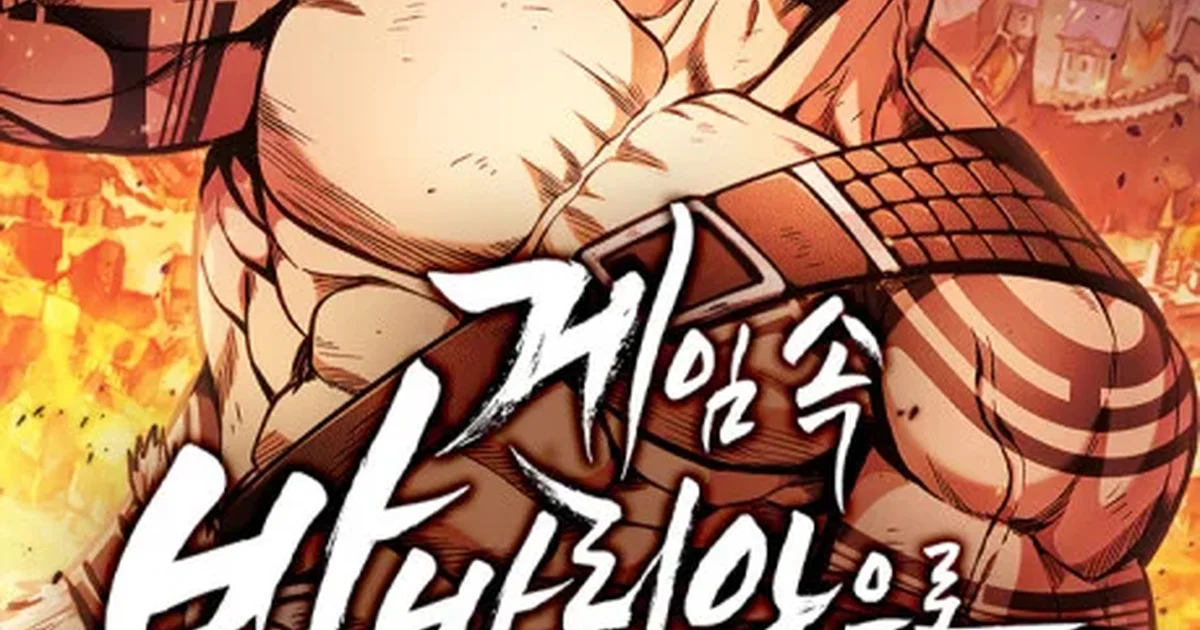
 The series' cover art leans into the premise directly: raw physical scale, no UI overlay, no system window in sight.
That absence is the point. It's also why the early chapters read differently from most of the genre. There's no moment where a status screen conveniently explains what Han-Su can do. Every capability the reader learns about, they learn because Han-Su demonstrates it under pressure, in a dungeon, against something that's actively trying to kill him. The information reveals through action, not exposition, which is a harder thing for a webtoon to pull off and one of the reasons the opening arc holds up.
Nine years of Dungeon and Stone: how game knowledge becomes strategy
The knowledge itself is specific, not vague "he's smart" writing. Han-Su recognizes dungeon layouts before he's fully inside them. He knows which bosses telegraph their real attack after a fake opening. He remembers spawn timing on enemies other players are encountering for the first time. None of this is stated as backstory exposition, it surfaces exactly when it's useful, which is what makes the early arcs feel earned rather than narrated.
The series is also careful to show the knowledge's edges. Han-Su played Dungeon and Stone from a screen, with save states and a UI that abstracted away physical consequence. Inside the world, hunger is real, injuries don't reset, and decisions carry weight they never did from a keyboard. Watching him recalibrate what "expertise" even means under those conditions is a more interesting problem than the genre usually bothers to pose.
The barbarian class problem: strong body, zero player privileges
Barbarian, in Dungeon and Stone's own system, was never meant to be played. It's an NPC classification: fixed behavior, no store access, no communication channel with actual players, and by default, treated as a hostile mob by anyone wearing the game's real player tag. That's the trap Han-Su wakes up inside.
The tension this creates runs through most of the series' strongest chapters. He knows things other players haven't discovered yet, upcoming events, safer routes, which NPCs are worth trusting, but he can't just tell anyone through the game's normal channels. He has to find workarounds that respect the constraint instead of writing around it, and watching the story stay honest about that limitation (rather than quietly forgetting it exists once it's inconvenient) is what separates this from a standard power-fantasy setup.
Who this reading guide is for
This is for readers deciding whether to start an ongoing series with no fixed end point, and for readers who started and stalled somewhere in the first ten chapters wondering if it picks up. If you specifically wanted a break from isekai protagonists who get handed a convenient system on page one, the setup here rewards that patience directly. If you need a completed series with a defined ending, this isn't it yet, AniList still lists it as RELEASING, and there's no announced conclusion.
Where to read Surviving the Game as a Barbarian
The English release runs on WEBTOON, which had passed 150 episodes as of late July 2026 with regular new releases. The review notes Tapas and Kakao Webtoon as English and Korean-language homes for the series as well, so availability spans more than one platform depending on region and translation preference. Chapter and episode numbering can vary slightly between platforms due to how raw chapters get split into released episodes, check whichever platform you're reading on directly for its current count rather than assuming it matches another site's numbering.
For more strength-and-knowledge-over-magic manhwa in a similar vein:
Best Action Manhwa 2026 →
Tips before you start
Read the first arc for the rules, not the action beats. This series front-loads its premise instead of its spectacle, and readers expecting immediate high-stakes combat sometimes bail before the setup resolves.
Don't expect a system-fantasy stat screen. If you're used to manhwa where numbers on a UI tell you exactly how strong someone is, recalibrate; this series measures strength through what characters can physically do, not through displayed numbers.
Keep the barbarian's in-world name in mind. Han-Su Lee is who he is; Bjorn Yandel is the identity the world assigns him. Other characters address him by the NPC name, which can read as confusing for a chapter or two if you're expecting everyone to know his real one.
If you liked the The Beginning After the End foreknowledge-as-advantage structure, or Overgeared's expertise-over-power theme, this series scratches a similar itch with a harder constraint, no magic at all, just a body and a memory of the game.
Frequently Asked Questions
Where should I start reading Surviving the Game as a Barbarian?
Chapter 1. There's no arc-skip shortcut here the way there is in some long-running system-fantasy manhwa. The opening chapters establish the no-system, no-magic constraint that the rest of the series depends on.
How many chapters does it have?
The WEBTOON English release had passed 150 episodes as of late July 2026, with new chapters releasing on a regular schedule. AniList lists the series as RELEASING with no fixed chapter total yet.
Is it confusing for new readers?
Not structurally. The plot is linear. What trips readers up is the premise's rules, no system window, no skill menu. The step-by-step section above covers what to track early so those rules land.
Do I need to know VRMMO mechanics to follow the story?
No. The series explains what Han-Su knows as he uses it. You just need to notice when he references something from his nine years of play that other characters don't understand yet.
Should I read the review or this guide first?
If you want the verdict and rating, read the review first. If you're deciding whether to start and want the reading order without spoilers past the setup, start here.
Is it a harem series?
There's a harem-adjacent dynamic in later arcs, but it's not the organizing structure the way it is in dedicated harem isekai. The early chapters are built around survival and the NPC-versus-player problem.
Related Reading
- Surviving the Game as a Barbarian Review: the rating and full verdict
- Best Isekai Manhwa: where this series fits against the wider genre
- Best Action Manhwa 2026: more strength-focused combat manhwa
- Best Manhwa OP MC: for readers who want the opposite of the barbarian's constraint
- Tomb Raider King Reading Guide: a completed series with a similar expertise-as-power structure
- Manhwa Like Surviving the Game as a Barbarian: 7 Picks
References
- Surviving the Game as a Barbarian on WEBTOON: official English release, episode list
- Surviving the Game as a Barbarian on AniList: series data, publication status, popularity ranking
Was this guide helpful?
About the author

Anime Critic & Adaptation Specialist
Anime critic and design writer who has reviewed 500+ series across 10 years. Paris-based. Has strong opinions about pacing, adaptation fidelity, and animation quality.
- 500+ anime series reviewed over 10 years
- Specialist in adaptation fidelity and animation quality critique
- Tracks major studios — MAPPA, Ufotable, Wit, CloverWorks
- 80+ hours per season logged for coverage



Disclaimer
This article is published for informational and entertainment purposes. It does not constitute professional financial, legal, or technical advice. Series availability, platform access, translation status, and chapter counts change. Verify critical details (pricing, regional availability, official translation status) with publishers and platforms. Affiliate links, where present, help support our editorial work and are labelled in our affiliate disclosure.